Submissions
Author Guidelines
2025 Updated instructions for authors
Actualización 2025 de instrucciones para autoras y autores
Received: 04/10/2025.
Approved: 06/10/2025.
The editorial process of this journal is carried out ONLINE. To upload an article, you must register as an author. From your user profile, you can send the article and track your submission. During submission, you have to complete the digital platform, providing all the metadata of each author.
This OPEN ACCESS journal DOES NOT CHARGE FEES OF ANY KIND at any stage of the editorial process; that is, for submission, processing, or publication of articles.
It also adheres to the Recommendations for the preparation, presentation, editing, and publication of academic papers in medical journals of the International Commitee of Medical Journal Editors (ICMJE). (http://www.icmje.org/journals-following-the-icmje-recommendations/)
The articles that do not comply with all the aspects outlined in these instructions for authors, will not be accepted for review.
How to review the guidelines for authors?
Before reviewing these guidelines, you should:
- Read the Journal Policies, which contain the general principles for the articles that we publish and the most important features of the evaluation and publication process.
- Review the General guidelines for all articles, which contain information about all the necessary requirements that any article submitted to this journal must meet.
- Finally, review the Particular Requirements according to the different types of articles.
ONLINE SUBMISSIONS
Do you already have a user's name and password for the Revista Archivos del Hospital Universitario "General Calixto García"? Go to Log in.
Do you need a user's name or password? Go to Registration.
Registration and user login are necessary for sending online items, and also for tracking the state of all the recent submissions.
GUIDELINES FOR AUTHORS:
Updated: September 30th 2025.
TABLE OF CONTENTS
GENERAL GUIDELINES FOR ALL ARTICLES SENT TO THE JOURNAL
Confidentiality
Data opening
Preprint Acceptance
Peer review process
About the title of the article
About the authors, affiliation and ORCID
Bibliographic references
Tables, figures, graphs and images
Ethical considerations
Drafting
Manuscript submission format
Copyright
Conflicts of interest
Languages
Units, symbols, equations, chemical formulas
About submissions
PARTICULAR REQUIREMENTS OF EVERY TYPE OF ARTICLES
- Editorial
II. Research article
III. Technology presentation
IV. Brief communication
V. Systematic review
VI. Case presentation
VII. Review article
VIII. Opinion article
IX. Letter to the Editor
X. Historical Review
XI. Review of event
XII. Obituary
GENERAL GUIDELINES FOR ALL ARTICLES SENT TO THE JOURNAL
Confidentiality
All articles sent to the Journal are handled confidentially. Authors can obtain information about the process of their articles at any time, in addition to the information that they obtain from their profile in the Journal. Information about any decisions made with the article are always sent to the authors via e-mail. It is the authors' responsibility to ensure that they receive messages from the Journal though their e-mail addresses.
It is also the authors' responsibilities or that of their institution of affiliation when a manuscript contains information that may be considered sensitive or with any degree of classification for publication. The Editorial Committee will request a written certification from the institution of affiliation, expressing its agreement to disclose the content of the article whenever needed.
Data opening
This journal adheres to openness and transparency in sharing research data and invites the authors to publicly display and reference the data, that is, the primary (surveys, interviews, questionnaires, forms) and secondary (databases) records used in their research, so that they can be shared and reused.
All articles must include a Data Availability Statement, even when there is no associated data. This statement provides full details on how, where, and under what conditions the data underlying the results can be accessed (or the data can be provided as supplementary files).
The data availability declaration must follow the following format:
"[Name of data repository]. [Title of data set]. [Persistent identifier, if any]"; also "The data is available under the terms of [License Name]."
Example: Figshare. Research database. Y2163152ada; The data are available under the terms of the Creative Commons BY-NC-SA 4.0 license.
If provided as Supplementary Files, please follow the following format:
"Supplementary file: [Dataset title]. [Data format; example IBM SPSS v.21, Excel 2019, etc.]".
Example: Supplementary file: Research database. Excel 2016.
Extended data
There is no limit of figures or tables for the Complementary Files in the articles sent to the Journal. Additional materials that are relevant and support the key statements of the document, but they are not absolutely necessary to follow the study design and analysis of the results, may be included as supplementary files; these include: questionnaires, images, or supporting tables. Descriptions of materials and methods must be provided in the main article. Extended data should be mentioned where relevant in the main textl.
Software and code
Whenever necessary, all articles should include details of any software and code that is required to view the data sets described, or to replicate the analysis. Include the version number of any software used to process, store or analyze data. When proprietary software is used, it must also include an open access alternative so that it can perform the same function.
Preprint Acceptance
The journal accepts articles that are deposited in preprint servers or another digital repository, social network, event, congress, and so on. In all cases it must be informed by the authors, and the location address must be indicated in the Comments to the Editor or at the end of the article.
Peer evaluation process
All articles sent to the journal will be subjected to an evaluation process by external reviewers, defined almost in the end, in the section: RECEPTION AND EVALUATION OF MANUSCRIPTS.
About the Title of the article
Avoid acronyms, abbreviations, names of countries, cities or institutions; it should not exceed 15 words; avoid interrogative titles and avoid dividing them with punctuation marks, whenever possible. If names of institutions are used, they must be official and updated. It should be presented in English and Spanish.
About the authors, affiliation and ORCID
This section includes those that meet the four criteria recommended by the ICMJE (http://www.icmje.org/recommendations/browse/roles-and-responsibilities/defining-the-role-of-authors-and-contributors.html).
The order in which the authors appear is the decision of the authorship team, however, an author for correspondence who will assume the responsibility to communicate with the Editorial Committee of the journal must be identified. This author will be available during all the Editorial process.
The full names and surnames of all authors must appear on a separate line in each case. Avoid initials. Professional titles, scientific degrees, academic degrees, teaching or research categories are not included. Each author´s ORCID must be included after the authors' names. One of the authors of the article will be the corresponding author; articles sent by people other than the authors are not accepted.
The Affiliation includes the full name of the institution to which each author belongs. The order must be as follows: First, the highest affiliation; next, the smallest organizational unit (up to 3), separated by full stops; then the City, and the Country.
Example of Title, Author with ORCID, and affiliation:
Original Title
(Next line) Translation of the title
(Next Line) (A/b 10 points, white font; Right, justified format) Research Article (2 enters) (1-line spacing) (A/b whites 14 points; Centered, Justified format) (2 enters) (1-line spacing)
Isabel Damaris Castañeda Pérez1* https://orcid.org/0000-0003-1041-7961 (1-line spacing)
1Affiliations: General Calixto García University Hospital (A/b white font; Left, Justified format)
(Each one in an independent line) (2 enters)
(1-line spacing)
*Corresponding author. Email: isadamaris@infomed.sld.cu (A/b White Font; Justified; Left) (2 enters)
Affiliation: The full name of the institution to which the authors belongs must be provided, the smallest areas of sub-domain must be separated by commas. The city and the country, separated by commas in the smallest areas of sub-domain, should be included. Authors´ positions are not included. Example:
General Calixto García University Hospital, University of Medical Sciences of Havana, General Calixto García Faculty, (X)... Departament, Havana, Cuba.
Authors' contributions:
They are included in the following types of articles:
Research articles
Brief communication
Technology presentation
Case presentation
Review article
Systematic review
In the case that there is a single author, you should note "Single Author" in the Author´s Contributions section.
CRediT Taxonomy should be used to record authors' contributions transparently. They allow researchers to be recognized and provide greater responsibility for those involved. You must include an Author´s Contributions section in your manuscript upon submission. Any person who has contributed, but does not meet the authorship criteria, should be included in the Acknowledgments section.
According to the CRediT taxonomy, the roles and their definition are as follows:
|
Role |
Definition of roles |
|
Conceptualization |
Ideas; formulation or evolution of overarching research goals and aims. |
|
Data curation |
Management activities to annotate (produce metadata), scrub data and maintain research data (including software code, where it is necessary for interpreting the data itself) for initial use and later re-use. |
|
Formal analysis |
Application of statistical, mathematical, computational, or other formal techniques to analyze or synthesize study data. |
|
Funding Acquisition |
Acquisition of the financial support for the project leading to this publication. |
|
Investigation |
Conducting a research and investigation process, specifically performing the experiments, or data/evidence collection. |
|
Methodology |
Development or design of methodology; creation of models. |
|
Project administration |
Management and coordination responsibility for the research activity planning and execution. |
|
Resources |
Provision of study materials, reagents, materials, patients, laboratory samples, animals, instrumentation, computing resources, or other analysis tools. |
|
Software |
Programming, software development; designing computer programs; implementation of the computer code and supporting algorithms; testing of existing code components. |
|
Supervision |
Oversight and leadership responsibility for the research activity planning and execution, including mentorship external to the core team. |
|
Validation |
Verification, whether as a part of the activity or separate, of the overall replication/reproducibility of results/experiments and other research outputs. |
|
Visualization |
Preparation, creation and/or presentation of the published work, specifically visualization/data presentation. |
|
Writing - original draft |
Preparation, creation and/or presentation of the published work, specifically writing the initial draft (including substantive translation). |
|
Writing: review & editing |
Preparation, creation and/or presentation of the published work by those from the original research group, specifically critical review, commentary or revision - including pre- or post-publication stages. |
How to report the author´s contributions?
If a role does not correspond or apply, do not include it in the declaration.
Conceptualization: Author 1, Author 2, Author n (Full names of the authors, without academic or scientific degrees, separated by commas.).
Data curation: Author 1, Author 2, Author n.
Formal Analysis: Author 1, Author 2, Author n.
Funding acquisition: Author 1, Author 2, Author n.
Research: Author 1, Author 2, Author n.
Methodology: Author 1, Author 2, Author n.
Project Administration: Author 1, Author 2, Author n.
Resources: Author 1, Author 2, Author n.
Software: Author 1, Author 2, Author n.
Supervision: Author 1, Author 2, Author n.
Validation: Author 1, Author 2, Author n.
Visualization: Author 1, Author 2, Author n.
Writing - original draft: Author 1, Author 2, Author n.
Writing - Review & editing: Author 1, Author 2, Author n.
Each article must be accompanied by a signed letter expressing the authorship contribution of each of the authors, which must conform to the taxonomy of these Credit contributor roles, available at https://casrai.org/credit/. The authorship roles will be identified in the following order, including each author in which it corresponds and omitting those that do not apply in each case.
The details regarding the contribution of each author must appear at the end of the text, in the section: Authors' contributions.
Any person who has contributed, but does not fulfil the authorship´s criteria should be included in the section: Acknowledgements.
Keywords
They should be concise words that represent the semantic content of the article, in both the main and secondary contexts. They can include from 3 to 7 keywords or key phrases.
The use of DeCS thesaurus is recommended (Descriptores en Ciencias de la Salud), which is available at: https://decs.bvsalud.org/E/homepagee.htm
Keywords are usually organized in alphabetical order.
Referencias bibliográficas
They will be placed in placed in Arabic numerals, superscript, in parentheses, after the punctuation mark, without a space from the preceding character, as follows: (1) When there are several consecutive cites, all of them are included, example: (1,2,3,4). URLs for references will be provided whenever possible and, on a mandatory basis if they come from journals or electronic sites that have doi.
The information about the date of access to the URL will appear in the following order and format: [access: dd/mm/yyyy]. (20/01/2025).
This Journal follows the regulations described in the Recommendations for manuscripts submitted to biomedical journals (Vancouver style). The translation of the Uniform Requirements for Manuscripts Submitted to Biomedical Journals into Spanish is available from: https://www.icmje.org/recommendations/browse/
You must ensure that the references used are the most up-to-date on the topic covered by the article, which depends on the type of article and field of knowledge it covers. Except for Case presentations with very low incidence diseases, it is recommended that, in other types of articles, no less than 70% of the references will be from the last 5 years (70% for Review Articles).
The list of BIBLIOGRAPHIC REFERENCES will be shown through a manual numerical list. The URL or DOI will be provided in all cases.
The use of URLs is preferred; the date of access will appear in the following order and format: [access: dd/mm/yyyy]. When the DOI is used, the date of consultation is not stated and reference will be made only to the locator, for example: DOI: 10.1109/5.bb1073.
Depending on the type of article, the bibliographic references will preferably be from primary sources, or from scientific documents that follow peer review guidelines.
Consider:
- Journal names should align with specific biomedicine standards and official abbreviations.
- Preprints can be cited and listed in the reference list.
- Unpublished abstracts, articles that have been submitted to a journal but have not yet been accepted and personal communications, should be included in the text (not in the reference list); they should be called "personal communications" or "unpublished work" and the researchers involved should be named. Authors are responsible for obtaining permission to mention any personal communications from referenced individuals.
- Web links (general pages that do not come from peer-reviewed scientific sources) should be included as hyperlinks within the main body of the article, but never as references. When it deals with legal normative documents, technical statements or others available on a website, it will be done in accordance with the specific format (monographs, law, regulations, etc.)
- When an author refers to the work of another author and the main source is not available, the author of the main source and the author of the work in which it was cited must be mentioned (cited by...).
- If a direct quote is used, it must be enclosed in quotation marks; if it has more than 2 lines, it should be inserted as a separate paragraph, indented.
- When a reference has more than 6 authors, only the first 6 are included in the reference list, followed by ", et al". As long as there are up to 6 authors, they all are included.
- When an author is mentioned in the text, it is written as "Surname + initial of first name(citation)" When there are several authors: from the first author "Surname + initial of first name + et al.(citation)". Note that the use of italics is part of the formatting.
Tables, figures, graphs and images
All figures and tables should be cited and discussed in the text of the article. The title and description of the figure should be added at the bottom of the figure (Fig. 1 - Title), and the title of the tables should be added at the top of the table (Table 1 - Title).
Tables must be formatted using Verdana font, size 10 and cannot be larger or wider than a letter format page, with 2.5 cm in each margin, including the title and the footer. Tables or spreadsheets of larger data cannot be included; use Supplementary Files whenever appropriate. The tables are not provided as an image, but only with text content.
Figure files can be uploaded as separate files via Supplementary Files (in this case you should point out their location in the text and note that they are supplied as a Supplementary File).
All photographs of people must be accompanied by the declaration of consent of those involved to publish them. Distinctive elements, including medical record numbers or codes in the case of clinical images, that could be used to identify the patient or participant, should be removed from the images. The editorial staff will carry out the masking of facial features that identify the patient through image processing for publication in order to maintain uniformity and aesthetics in the manipulation of the image that will be published.
All photographs of people must be accompanied by the declaration of consent of those involved in their publication. Distinctive elements, including medical record numbers or codes in the case of clinical images, that could be used to identify the patient or participant, should be removed from the images. The editorial staff will carry out the masking of facial features that identify the patient through image processing for publication in order to maintain uniformity and aesthetics in the manipulation of the image that will be published.
A legend describing the symbols and abbreviations used is provided at the bottom of the tables and figures. The legend should be detailed enough so that the figure or table can be separated from the main text.
Permissions: If a figure or table is reused from a previous publication, authors are responsible for obtaining permission from the copyright holder and paying any fees (if applicable). Include a note in the legend to indicate that:
"Source: This figure/table has been reproduced with permission of..." [include citation from original publication] or license, if applicable.
Figure formats: For all figures, the color mode must be RGB or grayscale.
Diagrams, flowcharts, and others: Make sure the text is at least 8 points, that the lines are thick enough to be seen clearly at the size at which the image is likely to be displayed, and that the size and type of font is consistent between images. Figures should be created with a white background to ensure they display correctly online.
If you send a graphic created with Word, Excel, or PowerPoint, it must be editable, not an image.
Photographs and images, including microscopy: Photographs and images must be submitted with a resolution of at least 200 dpi so that they are clearly visible at the size at which the image will be displayed.
Ethical considerations
All research works must be carried out within an appropriate ethical framework. In the Methods section, for studies involving humans or animals, details of approval by the authors' institution or an ethics committee should be provided in an explicit and verifiable manner.
Consent: For articles involving direct contact with patients/participants, authors should ensure they have obtained written informed consent or assent from all subjects involved (or their legal guardian in the case of a minor, or a next of kin if the participant is deceased). Authors should be prepared to provide copies of these documents upon request by Journal staff.
The research works presented must comply with ethical statements according to the design used, whether in humans or animals. (Declaración de Helsinki).
In relation to the ethics of scientific publication, the article should not contain fragments of texts from works previously published or in process of publication in journals or other media, without proper citation. Any ethical violation related to the document will be resolved using the protocols established by the International Committee on Ethics in Scientific Publication (COPE), that is, Publicación Científica (COPE), Publicaciones superpuestas, all of which lays the foundations for transparent, ethical, and efficient editorial management. As for the anti-plagiarism policy, the plagiarism detector PLAGIARISMA, is regularly used, in addition to the search for similarities on the Google Academic site. For the resolution of conflicts or in the case of duplicate publications, the Editorial Committee meets and decides whether or not to reject the manuscript, in accordance with the established by COPE: Comité de Ética de Publicaciones.
Intervention studies in humans
Any experimental study in humans, including clinical trials, must be identified as such and have the registration number, obtained in a public registry of clinical trials (in Cuba: http://registroclinico.sld.cu/, from WHO: https://www.who.int/ictrp/es/ or any other official registry, from which you must provide data).
This number must be verifiable; therefore, the source must be cited. In addition, they must comply with the evaluation parameters expressed in the international CONSORT guide (http://bvs.sld.cu/revistas/recursos/CONSORT.pdf).
Drafting
The document presented must ensure clarity and consistency of writing, syntax and spelling in the accepted languages. Special attention should be paid to the use of scientific language. The use of colloquial language, medical jargon, or phrases from another language must be avoided and translated into the language of the article; when phrases from another language are needed to be used, the term or phrase should be italicized.
The meaning of the abbreviations, acronyms and symbols used, must be explained in the text from the very beginning. The use of standard, universally accepted abbreviations is only recommended to facilitate the reading and interpretation of the text, but not to abbreviate it.
Manuscript presentation format
Articles will be presented in electronic text format .doc or .docx, in Times New Roman font 12 and 1.5. spacing. Other formats are not accepted. The length of the Body of the article (excluding the heading, abstract, acknowledgments, tables, figures and bibliographical references) will have the limits specified for each type of article.
Copyright
This Journal is available under a Creative Commons Atribution- NonComercial - ShareAlike4.0 International License. The contents presented here can be shared, copied and redistributed in any medium or format. They can be adapted, remixed, transformed or created from the document, using the following terms: Attribution (giving appropriate credit to the work, providing a link to the license, and indicating if changes have been made); non-commercial (you cannot use the material for commercial purposes) and share-alike (if you remix, transform or create new material from this work, you can distribute your contribution as long as you use the same license as the original work).
The Revista Archivos del Hospital Calixto García shares the Budapest initiative for Open Access and subscribes to it, considering "its free availability on the public Internet, allowing any user to read, download, copy, distribute, print, search or use them for any legal purpose, without any financial, legal or technical barrier, other than those that are inseparable from those involved in accessing the Internet itself. The only limitation regarding reproduction and distribution and the only role of copyright in this domain, must be given to the authors control over the integrity of their work and the right to be properly recognized and cited." (See http://www.budapestopenaccessinitiative.org/translations/spanishtranslation).
In accordance with this Open Access policy, there are no charges of any kind for subscription, submission, processing, publishing or reading articles from this journal at any steps of publication process.
Conflicts of interest
The articles published in Revista Archivos del Hospital Calixto García should not include any content that could be perceived as "advertising." In the Conflicts of Interest section, any competitive financial, personal or professional interest of the authors that could be interpreted as an undue influence on the content of the article must be declared. If you have no conflicts of interests, add the text "No conflicts of interest are declared."
At the end of the article, the authors must declare the presence or absence of conflicts of interest in relation to the work: whether the author or the institution received payment from third parties for any aspect of the work presented, specify the institutions and the type of relationship; the existence of the author's patents relevant to the work; and any other relationships, conditions, circumstances or activities that readers may perceive as a fact that is influencing on the work.
Funding
Indicate who funded the work, whether it is your employer, a grant funder, etc. Do not list funds you have received that are not relevant to this specific investigation. For each funder, list the name of the funder, the grant number (where applicable), and the person to whom the grant was awarded. If your work was not funded, include it in the section entitled "Conflicts of Interest" and say: "The authors declare that no grants were involved in this work."
Language
All articles must be written in (good) Spanish and American English (professional translation). Please note that the article will not be accepted for review and may be rejected during the initial verification process if the writing is deemed unintelligible and inappropriate for peer review.
Units, symbols, equations, chemical formulas
In accordance with best practices in technical language, the following tips are provided:
- For units and symbols, use the international system of units. When measurements are provided in other systems, insert conversions.
- for simple fractions in the text, use the slash "/" taking into account the need to insert parentheses whenever necessary to avoid ambiguities. The exceptions are the own fractions available (e. g., ¼, ½, ¾).
- Equations and formulas referenced in the text must be centered and inserted after the reference, using the Equation tool.
- Braces, square brackets, and parentheses should be used in the order {[( )]}, except when mathematical convention otherwise dictates.
About submissions
Articles that do not comply with these instructions are rejected and the author who made the submission is notified. It can be submitted again, as an update of the previous submission or as a new submission, once the recommendations have been satisfied. If it is rejected again in the initial review, it will not be admitted for evaluation again. New submissions will be reviewed within a period of up to 21 working days from their entry date. The date of reception of the article is counted from its admission for the review process.
Please note that each type of article also has other specifications that must be met, which are detailed in the Particular Requirements of the article types.
PARTICULAR REQUIREMENTS OF EVERY TYPES OF ARTICLES
- Editorial
II. Research article
III. Technology presentation
IV. Brief communication
V. Systematic review
VI. Case presentation
VII. Review article
VIII. Opinion article
IX. Letter to the Editor
X. Historical Review
XI. Review of event
XII. Obituary
XIII. Scientific event papers (provisional section)
I- Editorial
The Editorial section is written only at the request of the Editorial Committee.
II- Research Article
Length: It will not exceed 4 500 words, including The Bibliographic References and the Appendixes.
Abstract: The abstract must be structured by sections; it must have the following structure: Introduction- Objectives- Methods - Results - Limitations of the study - Conclusions. It will have a maximum length of 250 words and the use of abbreviations must be avoided. It should give a clear idea of what the work is about; it should also be described using the past tense, and it must be sent in Spanish and English (Abstract; professional translation).
Introduction
The background of the research should be presented clearly, with reference to previous work. The research question must be circumscribed to the article that is presented, as well as its objectives. Finally, the work objective (s) must be clearly defined.
Methods
This section should define the type of research or study, as well as the period and place where it was conducted. It must also define the study population or study group, as well as the inclusion, exclusion, and elimination criteria, whenever appropriate. The variables used must be clearly described. The methods used for the collection, processing and analysis of the information must be explained. The statistical method must adhere to the type of study. The particular ethical aspects of the study must be declared. The methods should fulfill the principle of being clear, allowing other researchers to understand how the study was performed and that can be reproduced, wherever considered.
The most appropriate standard format for most written methods will be:
- Design: All details about the research design.
- Subjects: Population, sample, sampling methods, sample size with appropriate details.
- Variables: Declaration of the variables used in the research to achieve the objectives.
- Procedures: Instruments, techniques and questionnaires used to collect data on the variables.
- Processing: All detailed processing carried out on the data of each variable, including statistical analysis, with the corresponding rationale and any required specifications.
- Bioethical issues: Corresponding bioethical statement, according to the research design and the units of analysis (human subjects, animals or others).
If the study involves the use of a questionnaire that has been validated in a previous study, reference to the validated questionnaire must be cited and provided. If the authors have created a novel questionnaire (or made a translation of an existing one, or a linguistic and cross-cultural adaptation), the article must indicate whether the questionnaire has been validated, and provide the following information:
- Initial validity test
- Preliminary pilot test
- Reliability tests (internal consistency, test- retest, inter-rater)
- Any changes implemented as a result of preliminary testing
The novel questionnaire and the previous information must be provided as a Supplementary File.
Results
The results should consist of an explanation of the work objectives. Stadigraphs should be appropriately used, whenever required. Figures and tables must highlight relevant results without repeating information among them.
Discussion
A critical analysis of the results should be presented in the light of the information published on the topic by other researchers, which can be similar or comparable. The scope and limitations must be explained; the possible applicability and generalization of the results must be described.
Conclusions: They are written at the end of the discussion and must have an adequate degree of generalization. They must respond to the objectives of the study and be in correspondence with the results and discussion. The results must not be repeated.
References: Only the necessary references must be included; they must be relevant and they must have certain degree of update according to the topic in question. The description of the Bibliographic References must be cited using the requirements of Vancouver Style, thus following the specifications presented in the general instructions.
Guidelines for submission of the article
Reporting guidelines standards help authors ensure that they have provided a complete description of their research, making it easier for others to evaluate and reproduce the work.
The articles sent to the Revista "Archivos del Hospital Calixto García" must comply with the minimum guidelines for all the reports, based on consensus for scientific research. Complete lists of Reporting Guidelines must be consulted, which are available from the Web site of EQUATOR network.
Checklists are available for a number of reporting guidelines, which include, among others:
- Randomized controlled trials (CONSORT).
- Observational studies (STROBE)
- Qualitative Research (COREQ; SRQR)
- Systematic reviews (PRISMA)
- Diagnostic/prognostic studies (STARD; TRIPOD)
- Case presentations (CARE)
- Preclinical animal studies (ARRIVE)
Clinical trials: Articles submitted to the Revista Archivos del Hospital Calixto García that report clinical trials should comply with CONSORT reporting guidelines. The original trial protocol, CONSORT checklist and flowchart can be uploaded as supplementary files. Any deviation from the original protocol should be explained in the article. The trial registration number and date of registration should be included in the Methods section. Registration details should be provided: registration name, registration number, registration date, and URL of the trial in the registration database. Public disclosure of clinical trial results is supported.
Animal research: The Journal supports the ARRIVE guidelines. We encourage authors to consult them before the beginning of their studies; in addition, all research involving animals should be reported in accordance with these guidelines, which apply to all species.
All articles reporting in vivo experiments must comply with the ARRIVE Essential 10 checklist, and we encourage authors to ensure that their reports conform to the full ARRIVE 2.0 checklist.
Charts and diagrams: They should be editable, i.e., the editor should be able to work within them without having to rework them, if changes are required.
This type of articles cannot have more than 5 tables, figures, graphs and diagrams in total; the source must be indicated, except for tables and graphs derived from the work itself.
III-Technology presentation article
It presents a technology related to medicine and public health services, either in its organizational or managerial aspects, assistance or teaching. It must have a length of up to 5 000 words, including references.
Up to 5 tables or figures can be included. The other guidelines for the article will be adjusted to the nature of the work, according to what is described for the different types of articles. For most Technology Presentation articles, the most appropriate standard format will be as follows:
- Introduction/Objectives
- Methods
- Presentation/Conclusions
IV-Brief Communication
It must follow the same instructions as those presented for a scientific research article, but it must not exceed the 3500 words, including the bibliographic references.
For most Short Communication articles, the most appropriate standard format will be as follows:
- Introduction/Objectives
- Methods
- Results
- Discussion/Conclusions
V- Systematic review
This page provides information on how to write a systematic review (with or without meta-analysis), including the key sections that should be present in the article.
Criteria
Systematic reviews should address a clearly formulated research question and use systematic and explicit methods to identify, select and critically appraise relevant published research on the topic. The Revista Archivos del Hospital Calixto García encourages authors to register their Systematic Review protocol in the PROSPERO database and, where appropriate, to endorse the PRISMA Statement. Systematic reviews (including meta-analyses) should comply with these guidelines.
- Title
- Authors
- Abstract
Abstracts should be no more than 250 words in length and provide a succinct summary of the article. Although the abstract should explain why the article may be of interest, the importance of the paper should not be exaggerated. Citations should not be provided in the abstract.
Abbreviations should be explained, whenever necessary. Abstracts should be structured as follows: Introduction (Background) - Objective - Methods - Results - Conclusions.
- Keywords
- Body of the article
The format of the main body of the article is flexible: it should be concise, easy to read and review; it should be presented in an appropriate format for the type of study presented. It should have no more than 3500 words and up to 5 tables/figures. For most Systematic Reviews, the most appropriate standard format will be as follows:
- Introduction
- Methods
- Results
- Discussion/ Conclusions
The Journal is committed to serving the research community by ensuring that two articles include the necessary information to allow others to reproduce the work.
The Methods section should provide enough detail to allow others to replicate the work. The section should also include a brief discussion of the allowances made (if any) to prevent bias or unwanted sources of variability. Any limitations of the data sets should be discussed.
The use of PRISMA guidelines, which should be with or without meta-analyses, is recommended for systematic reviews in order to show the search strategy; number of records identified (included or excluded); reasons for exclusions; quality assessment; and statistical procedures
.
- Data availability
- Guidelines for the presentation of the report
The Journal Archivos del Hospital Universitario "General Calixto García" supports the PRISMA Statement; systematic reviews and meta-analyses should comply with these guidelines. Authors should include a completed PRISMA checklist and flowchart with their systematic reviews; if they are not in the body of the article, they may be included as Supplementary files. Complete report checklists and flowcharts should be included in an approved general repository, together with the guideline type, repository name, DOI, and license in the data availability statement of the manuscript.
- Ethics and Consent
Publicly available documents are used as evidence to support the development of a systematic review. No ethics or consent statement is requested.
VI- Case Presentation
A medical case report should be original and provide adequate details of a patient or more than one patient (no more than 3 cases). It should describe a particularly novel or unusual case.
Length: It should not exceed 2500 words, without including the bibliographic references. (If it is a review "as regards one case", it is not considered as a case presentation. See instructions for review articles).
Abstract: It is structured by sections. In this case it should follow the following structure: Introduction - Objective(s) - Clinical case - Conclusions. It has a maximum limit of 250 words and should give an adequate idea of what the paper is about. It is written in past tense. It should be sent in Spanish and English (professional translation).
Introduction: It should describe clearly the reason why the case is presented, providing brief, clear and the most important background. The interest for the scientific community should be justified.
Clinical case: It describes the main aspects of the patient's clinical history, including the results of relevant complementary studies, treatment, and evolution. Medical thinking, evolution and outcome should be considered, whenever appropriate. Identification of rare clinical manifestations presented in the diagnostic discussion should be provided.
Comments: It should include all those comments on aspects of interest in relation to the case presented. The critical analysis of the authors (no more than three authors) should be considered.
Bibliographic references: They must be the necessary and pertinent ones.
Figures, tables, graphs and diagrams: No more than 3 of them should be included. They should be relevant to the case presented. In the case that they include photos of patients with signs that allow their identification, they should be masked, in an aesthetically pleasing way, respecting the patient.
VII- Review Article
Review articles provide a balanced and comprehensive overview of the latest advances or discoveries in a particular field and summarize topics that have not yet been covered in the same manner in the existing published literature. Reviews should be based on peer-reviewed literature and should not include new research, data or propose new hypotheses. The decision as to whether a review article is suitable for publication and subsequent peer review ultimately rests with the Editorial Board.
Length: It should not to exceed 5000 words, except for bibliographical references.
Abstract: The abstract should be structured by sections, as follows:
Introduction - Objective(s) - Subtitles - Conclusions. It should give an adequate idea of what the paper is about. It has a maximum limit of 250 words in Spanish and English (professional translation).
Introduction: A brief, clear and appropriate background, with bibliographic support, should be presented. It must be a topic of importance and relevance to science and support the scientific problem that originates the review; its purpose is to examine the previously published bibliography, according to the topic proposed in the objective; it should be coherent with the title. At the end, it must clearly describe the objectives. It includes: the criteria and justification for the selection of the sources consulted, search engines used, period taken for the review, and criteria for the selection of the articles reviewed.
The development should not constitute a subtitle, but only the aspects dealt with in the summary should appear in it, with the thematic subtitles that the author considers necessary, as a script.
Figures and tables (no more than 5) can be used to highlight relevant aspects, without repeating information. The interpretation of the results indicated in the literature consulted should be provided. This type of article should contrast the differences and coincidences of the studies analyzed.
A review of the results of the study should be made in the light of works published by other researchers.
The likely applicability and generalization of the results should be described; new aspects to be considered (if necessary) should be included; the limitations or contributions of the review should be pointed out or highlighted. Scholarly and critical evaluations of the published literature, as well as their completeness, are preferred.
In the event of a review which had not been previously reviewed or a controversial topic, space should be devoted to the historical origins.
If it deals with a topic that has been competently reviewed before, the starting point of your paper will be the date of the previous review (not the date of publication, but the date up to which the literature was reviewed). Remember to mention the previous review article.
The conclusions should respond qualitatively to the objectives of the work. Clear, concise and pertinent conclusions should be stated and placed at the end of the developed subtitles. For most review articles, the most appropriate standard format will be as follows:
- Introduction/Objectives
- Methods
- Development/Conclusions
References: There should be as many references as necessary, and they have to be well delimited. They should be adequately updated, according to the topic presented.
VIII- Opinion Article
It expresses the authors' opinions on a topic related to the journal's profile. Even though its publication is approved, the Editorial Committee or the Direction of the General Calixto García University Hospital might not share or agree with what has been published.
Length: It should not to exceed 5000 words, including bibliographical references.
Abstract: It should be unstructured, describing the purpose of the article as well as its main elements in no more than 250 words. It should be presented in Spanish and English (professional translation).
Introduction: The background of the article and the main motivations for its submission for publication should be presented in a clear and concise way. Topics of importance and relevance to the medical sciences are recommended, either because it generates debate or because the opinion expressed contributes to the development of this field. The objective of the article should be clearly stated at the end.
The development should not constitute a subtitle, but only the aspects outlined in the abstract should appear in it, including the thematic subtitles that the author considers necessary as a script. It expresses the author's opinion on the topic in question, substantiated and supported by the corresponding quotations. When a controversial topic is discussed, it will be done in an appropriate manner, without personal allusions to other authors, only to the results published by them.
Conclusions: They respond to the objectives of the article, in a clear, concrete and pertinent manner.
Recommendations: When appropriate and on the basis of the opinions collected and analyzed in the article, the author will make the corresponding recommendations.
IX- Letter to the Editor
The letter to the editor includes brief comments, which relate directly to one or more articles published in the Journal or elsewhere. Any critical analysis of previously published studies should be presented in the form of an academic discussion, supported by references to published literature or new data.
Note that a complete reanalysis of a published study may be more appropriate as a research article. Also, it is important to highlight that if a brief comment does not make a new contribution to the published article, it will not be considered for evaluation.
We recommend that authors raise any concerns related to previous studies with the original authors before they submit their article for publication so that any possible misunderstandings can be clarified before publication.
Papers expressing the authors' ideas, opinions, positions or disagreements in relation to some of the contents published in the journal or other topics will be received. They are published after the evaluation performed by the Editorial Committee or peer review, if necessary. The arguments presented must have their corresponding bibliographic support, according to the rules adopted by the journal.
- Historical Review
Criteria
Historical review articles report or analyze facts or characters relevant to the history of medicine at the Hospital Universitario "General Calixto García" or of medicine in general. It is considered relevant if the facts or characters presented enrich the knowledge of the history of medical sciences due to their important contribution; influence in these fields; and scientific, practical or teaching contributions. It may be the result of a historical research, but not the research; in this case, we recommend sending the article to journals of a different profile.
- Authors
- 2. Title
- 3. Abstract
The abstract of the historical article should have a maximum length of 250 words and provide a brief summary of the fundamental content of the article. It will not be structured, but a logical order of the ideas, which allows the content to be adequately appreciated, is recommended.
- Keywords
- Body of the article
The format of the main body of the article is flexible. It should be concise and presented as an academic publication, using the scientific language of the biomedical sciences. The main body should have a maximum length of 6000 words.
- Data and software availability
The data availability statement should read: "There are no data associated with this article".
- Authors' contributions
It is not requested for this type of article.
- Event Review
It consists on the report on an event of interest to the journal's profile. The text should clearly state the name of the event, its objectives, participants, topics discussed, conclusions and pertinent recommendations, as well as any other information that is considered of interest.
XII. Obituary
This is the commentary on a news item about a person who died recently. It should give an account of the context, public significance, and the meaning of life of the recently deceased. Obituary is also known as necrology.
XIII. Scientific event papers (provisional section)
This section will be provisional during the academic year until all the works submitted by their authors are processed by the Editorial Committee and are sent to their final sections for publication during the year.
RECEPTION AND EVALUATION OF MANUSCRIPTS
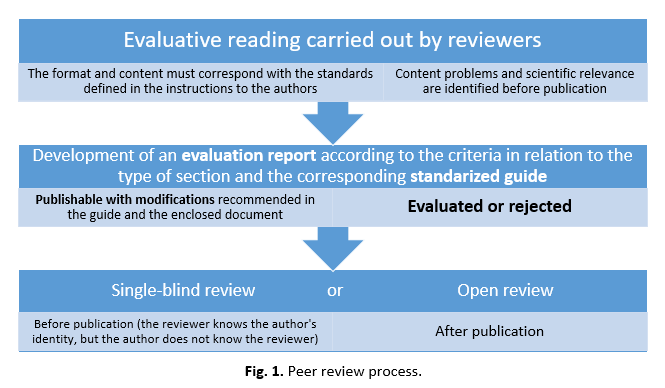
This journal conveniently uses open peer review practices as a mechanism to favor transparency in the editorial and scientific communication process. Articles will be submitted to a single-blind peer review process.
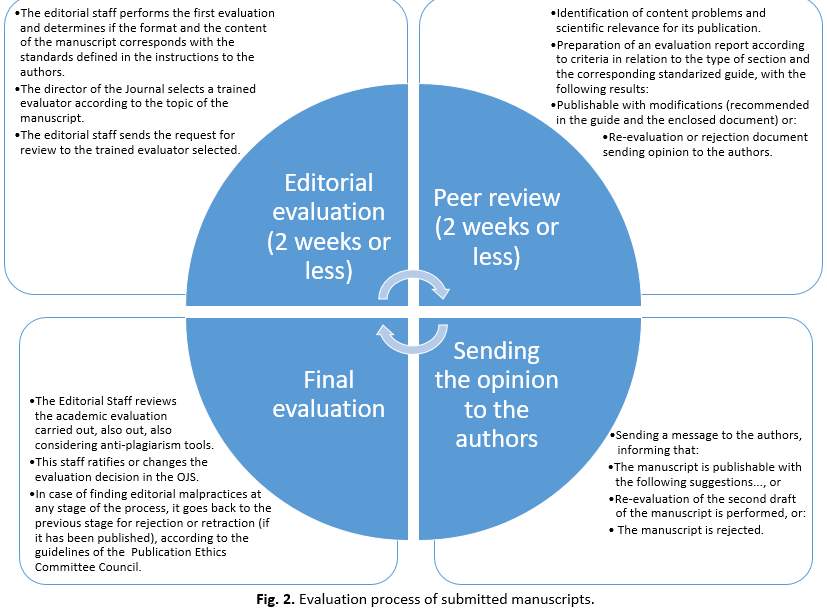
The evaluation period will be up to 60 days. Within this period the authors will be informed about the editorial decision.
If the article is returned to the authors to satisfy recommendations made during the evaluation process, and as a consequence, subsequent evaluations are necessary, the decision of the Editorial Committee will not take more than 60 days from the last date of receipt of the article.
Acceptance of the article for evaluation does not imply a commitment to publish it; this is evident once the article is approved by the Editorial Committee.
The decision of the Editorial Committee not to publish an article cannot be appealed, however, authors can send their opinion to the Editorial Committee. See: Fig. 1 and Fig. 2.
The authors should communicate in writing to the Editorial Committee of the journal if, for any reason they have decided not to publish the article, even when it has been submitted and is under editorial process; this might avoid an ethical conflict.
Articles may be submitted in Spanish or English. When submitted in English, a Spanish version must also be submitted.
Checklist for the preparation of submissions
As part of the submission process, authors are required to check that their submission complies with all the elements shown below. Submissions that do not meet these guidelines and those outlined above will be returned to the authors:
- The submission has not been previously published or submitted for consideration by any other journal (or an explanation has been provided in the Comments to the Editor).
- The submission file is in .doc or .docx format.
- URLs are provided for references, whenever possible.
- All illustrations, figures and tables are placed in the appropriate places in the text, rather than at the end.
- Web addresses have been added for references where possible.
- Italics are used in the text instead of underlining (except for URL addresses); all illustrations, figures and tables are in the appropriate places in the text rather than at the end of the text.
- It contains the authorship contribution based on the CRediT taxonomy, adopted by good editorial practices.
- It has the ORCID Identifier numbers for each author. Copyright notice.
Those authors who submit their articles to this journal should accept the following terms:
- Authors will retain their copyright and grant the journal the right of a first publication of their work, which will be subject simultaneously to the Creative Commons Acknowledgment License that allows third parties to share the work as long as its author and first publication in this journal are indicated.
- Authors may adopt other non-exclusive license agreements for distribution of the published version of the work (e.g., deposit it in an institutional telematics archive or publish it in a monographic volume) as long as the initial publication in this journal is indicated.
- Authors are permitted and encouraged to disseminate their work via the Internet. (e.g., in institutional telematics archives or on their websites) before and during the submission process, which may lead to interesting exchanges and increase citations of the published work (see The Open Access Effect).
Privacy Statement
Names and email addresses entered in this journal will be used exclusively for the purposes stated in this journal and will not be provided to third parties or used for other purposes.
The present Guidelines for authors, in addition to the traditional instructions of the Journal Archivos del Hospital Universitario "General Calixto García", are also based on those of the Open Access Publishing Platform F1000Research, available at:
- https://f1000research.com/forauthors/article-guidelines (licenses) Available from: https://creativecommons.org/licenses;
- Open Access Declaration of the SciELO network. Available from: https://scielo.org/es/sobre-elscielo/declaracion-de-accesso-abierto;
- Good practices for the editorial processes of scientific journals for LILACS. Available from: https://lilacs.bvsalud.org/es/sesiones-virtuales-lilacs/buenaspracticas-en-los-procesos-editoriales-de-revistas-cientificas-para-lilacs-2;
- COPE Council. COPE flowcharts and infographics - Suspected manipulation of peer review during the peer review process- English. [Access: 05/09/2025]. Available from: https://doi.org/10.24318/cope.2019.2.20
- COPE Council. COPE Retraction guidelines - English. DOI: https://doi.org/10.24318/cope.2019.1.4. [Access: 05/09/2025]. Available from: https://publicationethics.org/guidance/guideline/retraction-guidelines
Editorial
Esta dirigido a la diferentes aspectos en orden historico, científico, investigativo y docente que tenga lugar en el Hospital Universitario "General Calixto García"
Artículos de Investigación
Describen los resultados originales de la investigación. Los mismos serán trabajos de investigación de cualquier esfera de ciencias médicas. Deben constituir un aporte en el campo de la investigación.
Extensión: 4500 palabras, incluyendo referencias bibliográficas.
Número de tablas y figuras: Hasta 5 en el cuerpo del artículo. Las restantes deben enviarse como archivos complementarios.
Estructura
Presentación:
Nombre de la institución que se acredita la .investigación.
Título: Expresa el contenido del trabajo de forma breve, concisa y clara en no más de 15 palabras. No se deben usar abreviaturas ni siglas.
Autores: Nombres y apellidos completos de todos los autores ordenados según su participación (si el número es superior a 6 se aclarará, por escrito, el aporte de cada uno en la investigación o preparación del artículo); grado científico y categoría docente o investigativa más importante de cada autor.
Resumen: No debe tener más de 250 palabras en idioma español e inglés, contentivo de los propósitos, procedimientos o métodos empleados, resultados más relevantes y principales conclusiones del trabajo al igual que cualquier aspecto novedoso. Su estructura debe ser la siguiente, en párrafos separados:
Introducción, Objetivo, Métodos, Limitaciones y Conclusiones.
Palabras claves: El autor reflejará el contenido del documento a partir de 3 a 10 términos o frases (palabras clave) al pie del resumen y en orden de importancia. Estas deben haber sido extraídas del sitio https://decs.bvsalud.org/es/edicion-actual/.
Introducción: Se definirá tanto el tema que se abordará en el trabajo como sus antecedentes. Se expondrán los objetivos del estudio, así como la justificación para su realización. No se incluirán datos ni conclusiones propias del trabajo.
Métodos: Reflejará el tipo de estudio, lugar, tiempo, universo, muestra, criterios de inclusión y exclusión, variables estudiadas, así como los procedimientos y técnicas empleadas (de muestreo, pruebas estadísticas, diagnósticas, etc.).
Resultados: Se exponen de manera clara, sintética, lógica y coherente. Relatan pero no interpretan las observaciones. La exposición se auxilia de tablas, gráficos y anexos. Su contenido no se duplica en el texto.
Discusión: En el acápite de discusión se tratarán los aspectos novedosos aportados por la investigación. Se explicará el significado de los resultados comparándolos con los obtenidos por otros autores. No deben aparecer datos que no se hayan descrito en los resultados. No se repetirán los aspectos desarrollados en la introducción y los resultados.
Conclusiones: Se expondrán las conclusiones en consonancia con los objetivos del trabajo, evitándose conclusiones o extrapolaciones injustificables con los datos utilizados. Se recomiendan nuevos estudios.
Referencias bibliográficas: Deben ir numeradas y ordenadas en el texto. Su número debe limitarse a aquellas que son indispensables para la realización y comprensión del trabajo. Debe estar actualizada, por lo que el 80 por ciento de las referencias debe ubicarse entre 3 y 5 años de antigüedad.
Apéndices o anexos: Se consideran necesarios o convenientes para la mejor comprensión del trabajo.
Artículos de Revisión
Es el artículo que se refiere a documentos ya publicados, en el mismo se recopila, analiza y sintetiza el estado actual de un tema en particular. Su autor debe indicar el propósito de la revisión, fuentes y métodos de búsqueda de las referencias. El artículo de revisión, aunque a veces puede contener datos nuevos, su finalidad es examinar la bibliografía publicada anteriormente y situarla con cierta perspectiva, ofreciendo una evaluación crítica de la misma, en él se llega a conclusiones importantes basadas en los trabajos que se analizan.
Extensión: Hasta 15 páginas
Se admitirán 6 tablas ó 6 figuras
Estructura:
Presentación: Nombre de la institución de los autores.
Título: Expresa el contenido del trabajo de forma breve, concisa y clara en no más de 15 palabras. No se deben usar abreviaturas ni siglas.
Autores: Nombres y apellidos completos de todos los autores ordenados según su participación (si el número es superior a 6 se aclarará, por escrito, el aporte de cada uno en la investigación o preparación del artículo); grado científico y categoría docente o investigativa más importante de cada autor.
Resumen: No debe tener más de 150 palabras en idioma español e inglés, contentivo de los objetivos, fuentes y métodos de búsqueda de las referencias y principales conclusiones.
Palabras claves: El autor reflejará el contenido de la revisión a partir de 3 a 10 términos o frases (palabras clave) al pie del resumen y en orden de importancia.
Introducción: Expone los antecedentes históricos del tema y su situación actual. También se debe indicar el propósito de la revisión.
Desarrollo: Debe abordarse la temática de forma organizada, por acápite. Se expresa la síntesis de la información recogida, la cual, como requisito fundamental, será actualizada.
Conclusiones: Hace referencia a los hallazgos más relevantes de la búsqueda. Expresa si se cumple o no el propósito de la revisión.
Bibliografía: Deben ir numeradas y ordenadas en el texto. La misma será amplia (de 40 a 50 referencias bibliográficas) y el 80% o más debe tener menos de 5 años de editada.
Presentación de Casos
Son artículos que describen uno o varios casos clínicos de excepcional observación, o algún nuevo aspecto de una enfermedad o síndrome previamente conocido, que represente un aporte de especial interés para el conocimiento del tema o el proceso descrito. Se publicarán casos de pacientes con afecciones de interés docente, científico y asistencial por cuanto constituye un desafío diagnostico-terapéutico. Se entiende como caso interesante:
·Las presentaciones atípicas de enfermedades de alta frecuencia en nuestro medio.
·Afecciones de baja frecuencia, reemergente o subdiagnosticada
·Complicaciones poco frecuentes de enfermedades comunes
·Pacientes en los que se describan signos clínicos y paraclínicos explicables fisiopatologicamente, pero no descritos en la literatura
Extensión: Hasta 2500 palabras.
Estructura:
Presentación: Debe aparecer el nombre de la Institución. Debajo se colocan los nombres y apellidos de los autores.
Introducción. Se presenta brevemente el caso y se explica por qué tiene valor para ser publicado. Será breve. Se relata la historia del enfermo de forma sencilla, cuidando la secuencia narrativa.
Datos generales: La edad, sexo, raza como elementos a notificar en todo paciente. La profesión, estado civil y procedencia en cuanto constituyan datos de importancia diagnóstica, al ser un factor de riesgo, predisponente o de progresión
Motivo de ingreso
Historia de la enfermedad actual
Antecedentes Patológicos Personales y Familiares
Datos positivos al interrogatorio
Signos positivos al examen físico
Complementarios
Diagnóstico (s)
En caso que sea necesario se indicarán los procedimientos quirúrgicos y necropsia.
Comentarios (discusión).- Se analiza lo excepcional que se describe y se expone la discusión diagnóstica con el diagnóstico definitivo.
Referencias bibliográficas: No más de 10 referencias.
Revisión histórica
Serán publicado los artículos de los nombres de los pabellones del Hospital Universitario "Gral Calixto García", así como los medicos y profesores que por sus aportes a la medicina el Cuerpo edictorial apruebe.Obituario
Los medicos especialistas y profesores trabajadores del Hospital Universitario Gral Calixto García, que por su trayectoria científica e investigativa merite hacer un homenaje postmortemPonencias de Convención Calixto 2026 (sección Provisional)
Esta sección será Provisional durante el año 2026, hasta que todas los trabajos enviados por sus autores/as se vayan procesando por parte del Comité Editorial y sean enviados a sus Secciones definitivas para publicar durante el año en curso. Tendrán prioridad para publicarse los trabajos de investigación en ciencias de la salud.
Copyright Notice
Aquellos autores/as que tengan publicaciones con esta revista, aceptan los términos siguientes:
- Los autores/as conservarán sus derechos de autor y garantizarán a la revista el derecho de primera publicación de su obra, el cuál estará simultáneamente sujeto a la Licencia Creative Commons Atribución– No Comercial 4.0 que permite el uso, distribución y reproducción no comerciales y sin restricciones en cualquier medio, siempre que sea debidamente citada la fuente primaria de publicación.
- Los autores/as podrán adoptar otros acuerdos de licencia no exclusiva de distribución de la versión de la obra publicada (p. ej.: depositarla en un archivo telemático institucional o publicarla en un volumen monográfico) siempre que se indique la publicación inicial en esta revista.
- Se permite y recomienda a los autores/as difundir su obra a través de Internet (p. ej.: en archivos telemáticos institucionales o en su página web) antes y durante el proceso de envío, lo cual puede producir intercambios interesantes y aumentar las citas de la obra publicada.
 Guidelines for auhors - Download